RINGS
Diamond Engagement Rings
Dress Rings & Vintage Rings
Emerald Rings
Eternity Rings
Sapphire Rings
Ruby Rings
Opal Rings
Amethyst Rings
Aquamarine Rings
Tourmaline Rings
Antique Claddagh Rings






€7950
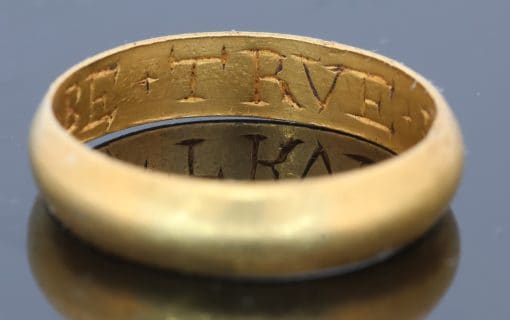
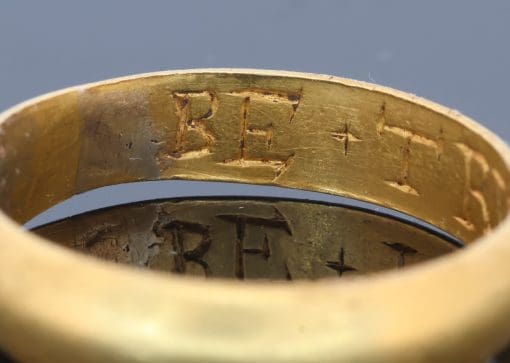
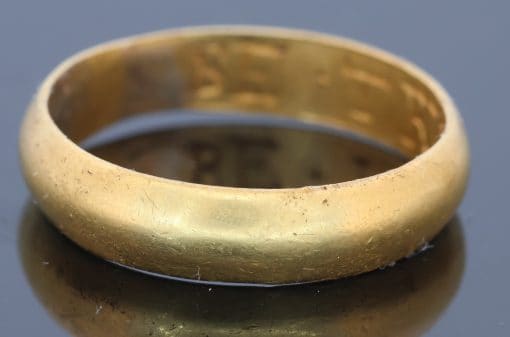
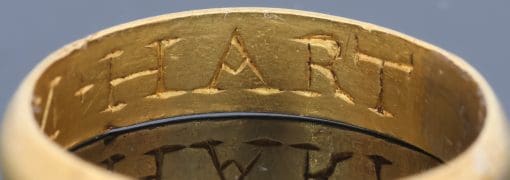
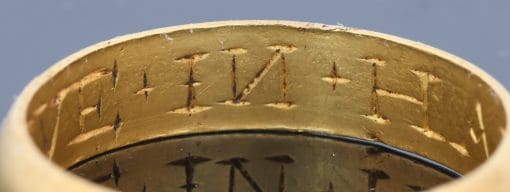
An extremely rare Tudor gold posy ringA posy ring is a historic ring bearing a short sentimental, religious or poetic inscription, usually engraved on the inside or outside of the band. The name derives from “posy”,... More, engraved to the interior with the wonderfully intimate inscription “BE TRVE IN HART”, meaning “Be true in heart.”
The ring was found by a metal detectorist in Shropshire in October 2024, adding a remarkable modern chapter to its long history. Posy rings were deeply personal jewels, traditionally engraved with short expressions of love, loyalty or devotion, and this inscription is particularly evocative in its simplicity.
Examples bearing this distinctive Gothic-style lettering tend to date to around 1600, placing this ring at a fascinating point between the Tudor and early Stuart periods. Comparable examples can be found in the collections of both the British Museum and the VictoriaVictorian jewellery refers to jewellery made during the reign of Queen Victoria, from 1837 to 1901. It is one of the most varied periods in jewellery history, encompassing romantic, sentimental,... More and Albert Museum.
The ring is fashioned in gold, with the inscription “BE TRVE IN HART” engraved within the band in period Gothic-style lettering.
The use of “TRVE” rather than “TRUE” reflects the orthography commonly encountered in early inscriptions, while the abbreviated form of the message gives it the character of a private declaration intended to be worn close to the wearer.
Its survival, discovery in Shropshire and close parallels in major museum collections make it an especially significant example of early English sentimental jewellerySentimental Jewellery refers to jewellery designed to express personal feelings, relationships, memories or emotional attachment. It was particularly popular during the Georgian and Victorian periods, when jewellery could carry meanings... More.
A remarkable piece for the collector of early English jewellery, with an appeal extending well beyond its beauty as a gold ring. The intimate inscription provides a direct connection with the sentiments of its original wearer, while its Tudor date and archaeological discovery give it an exceptional historical dimension.
| Item | Ring |
|---|---|
| Period | 17th century |

Dress Rings and Vintage Rings
Dress Rings and Vintage Rings
Dress Rings and Vintage Rings
Dress Rings and Vintage Rings

Amethyst Rings
Dress Rings and Vintage Rings
Dress Rings and Vintage Rings
Dress Rings and Vintage Rings